Anti-Repression Day


The Continuing Struggle for Dignity and Justice in Manipur
By Rajkumar Bobichand
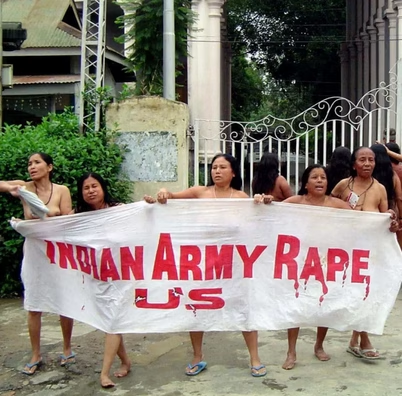
Every year on July 15, the people of India’s Northeast State of Manipur observe Anti-Repression Day, remembering one of the most extraordinary and courageous acts of civil resistance in modern history. On that day in 2004, twelve Manipuri women stood naked before the Western Gate of Kangla, then occupied by the Assam Rifles, an Indian paramilitary force, carrying banners that read, “Indian Army Rape Us” and “Indian Army Take Our Flesh.” Their unprecedented protest shook the conscience of the country and the world.

In the continued agitation against the Armed Forces (Special Powers) Act, 1958 (AFSPA), the protest came in response to the custodial torture, rape and killing of 32 year old young woman Thangjam Monoroma on July 11, 2004 by personnel of the 17th Assam Rifles.
Monoroma was picked by the personnel of the 17th Assam Rifles in the night on July 10, 2004 from her house. But the twelve women’s action was much more than a protest against a single atrocity. It was an indictment of an entire system of militarised governance under the Armed Forces (Special Powers) Act, 1958 that had reduced ordinary citizens to subjects living under fear, suspicion and extraordinary state power.
Their demands were clear: remove the Assam Rifles from Kangla, restore the dignity of the historic seat of Manipur’s civilisation since 33AD, and repeal AFSPA.
The significance of their protest has not diminished with time. If anything, it has become even more relevant today.
A History of Resistance Against Repression
The history of modern Manipur cannot be understood without recognising the long struggle of its people against different forms of repression. Long before the enactment of AFSPA, the people had resisted colonial domination including British, fought for democratic rights and defended their political identity.
Since AFSPA was imposed in Manipur, however, an extraordinary legal regime has profoundly shaped everyday life.
The Act granted sweeping powers to the armed forces operating in “disturbed areas,” including powers of arrest, search and the use of lethal force under broad circumstances.
Section 4(a) of the Armed Forces (Special Powers) Act, 1958 (AFSPA) explicitly grants any non-commissioned officer (or officer of equivalent rank not less than a Havildar) in the armed forces the power to shoot, even to the extent of causing death.
For decades, the people have argued that these extraordinary powers have often been exercised without adequate accountability, giving rise to serious allegations of arbitrary detention, torture, enforced disappearances, sexual violence and extrajudicial killings.
The most painful reality is that these allegations have never remained mere statistics. Behind every number is a family that lost a son, daughter, father, mother or sibling; behind every incident lies a community carrying memories of grief that have never fully healed.
One of the gravest chapters in this history concerns the alleged fake encounters carried out during counter-insurgency operations. Human rights organisations – Human Rights Alert (HRA) and Extrajudicial Execution Victim Families Association (EEVFAM) documented numerous cases over many years, and petition before the Supreme Court of India brought attention to 1,528 extrajudicial killings.
The proceedings before the Court represented a rare acknowledgement that serious questions existed regarding the conduct of security operations and the accountability mechanisms surrounding them.
Yet many families continue to wait for justice. Investigations have been slow, prosecutions limited, and closure remains elusive. For the victims’ families, justice delayed has increasingly become justice denied.
The struggle against repression, therefore, has never been merely a legal or political campaign. It has always been a struggle to reclaim human dignity.
Kangla: More Than a Military Camp
The women’s protest in 2004 also carried profound symbolic meaning because it took place before Kangla.
Kangla is not merely an archaeological site. It is the historical and civilisational heart of Manipur, the ancient seat of its kings and political authority for nearly two millennia.
The occupation of Kangla by military forces after the Anglo-Manipur War of 1891 had itself become a powerful symbol of political subjugation.
When the women demanded the removal of the Assam Rifles from Kangla, they were demanding far more than the relocation of a military camp. They sought the restoration of a people’s dignity, history and collective memory.
The eventual removal of the Assam Rifles and handing back of Kangla to the people of Manipur on November 20, 2004 by the Prime Minister of India Dr. Manmohn Singh, and withdrawal of AFSPA on August 12, 2004 from the seven Assembly Constituencies within the Imphal Municipal Area by the Government of Manipur headed by Chief Minister Okram Ibobi were therefore celebrated not simply as an administrative decision but as a moral victory born from people’s resistance.
The Meaning of Repression Has Expanded
Twenty-two years after the historic protest, Manipur finds itself confronting another painful chapter.
Since the outbreak of the violent conflict on May 3, 2023 when Kuki-Zomi militants attacked the Meitei civilians in Churachandpur, Kangpokpi, Meitei villages in Imphal East district in the bordering areas of Kangpokpi district, and Indo-Myanmar border town of Moreh; and reprisals from the Meiteis in Imphal Valley against the Kuki-Zomis from May 4, large parts of the state have witnessed a breakdown of normal civic life. More than 61,000 people have been displaced. Entire villages have been destroyed.
Communities that once lived alongside one another have become physically separated. Buffer zones now divide populations that historically shared markets, schools, workplaces and public institutions.
The continuing crisis has transformed the meaning of repression.
Today, repression cannot be understood only as actions carried out under AFSPA or by security forces. It also manifests itself in the denial of basic freedoms that ordinarily define democratic citizenship.
Thousand become Internally Displaced People (IDPs) in their own state. Many citizens cannot freely travel across their own state. Families remain separated. Access to education, healthcare, livelihoods and places of worship has been disrupted. Economic activity has suffered immensely. Psychological trauma has become widespread, particularly among children who have grown up amid violence and uncertainty.
The constitutional promise of equality before the law, freedom of movement, protection of life and liberty, and equal access to public institutions becomes difficult to realise when society itself is fragmented into isolated ethnic enclaves.
Even where no law formally suspends constitutional rights, conditions on the ground may effectively prevent citizens from enjoying them.
This reality demands serious reflection.
Repression Comes in Many Forms
History teaches that repression is rarely confined to one institution or one actor.
It may originate through excessive state power. It may emerge through armed violence. It may arise through intimidation by militant organisations. It may appear through ethnic hatred, collective punishment, misinformation, coercion, threats against dissenting voices, or systematic discrimination.
Whenever fear replaces freedom, repression has begun.
Whenever ordinary citizens cannot speak without intimidation, repression has begun.
Whenever communities are compelled to accept violence as normal, repression has begun.
Whenever justice becomes selective depending upon ethnicity or political affiliation, repression has begun.
Whenever victims are remembered only if they belong to one’s own community, repression has begun.
The lesson of Anti-Repression Day is therefore universal. It calls upon society to reject every form of domination that strips human beings of dignity, regardless of who exercises that power.
The Moral Courage of the Mothers
The twelve women who stood before Kangla did not possess weapons, political office or institutional authority.
They possessed something far more powerful.
They possessed moral courage.
Their act transformed unbearable humiliation into collective resistance. They challenged one of the world’s largest military establishments not through violence but through extraordinary moral conviction.
Their protest reminded the world that the human body itself could become a language of resistance when every other avenue appeared closed.
Their courage continues to inspire movements for justice not only in Manipur but across the world.
Yet honouring their sacrifice requires more than annual remembrance.
It requires continuing the principles they embodied.
A Democratic Society Requires Constant Vigilance
Democracy is not measured merely by elections or constitutional texts.
It is measured by whether ordinary citizens can live without fear.
It is measured by whether institutions remain accountable.
It is measured by whether victims receive justice irrespective of identity.
It is measured by whether governments listen to the voices of those who suffer.
Most importantly, democracy requires citizens who refuse to become indifferent to injustice.
The struggle against repression therefore belongs not only to governments or courts. It belongs equally to civil society, students, women’s organisations, journalists, lawyers, religious leaders, academics, artists and ordinary citizens.
Silence allows repression to deepen.
Public conscience prevents it from becoming normal.
The Present Generation’s Responsibility
The generation that witnessed the events of 2004 is gradually giving way to a younger generation whose memories are now shaped primarily by the violence that began in May 2023.
For many young people, conflict has become the normal condition of life.
This is perhaps the greatest danger.
When prolonged violence becomes normal, societies gradually lose the ability to imagine peace.
When fear becomes routine, freedom begins to appear exceptional.
When division becomes permanent, reconciliation becomes increasingly difficult.
The responsibility of the present generation is therefore not simply to remember past struggles but to prevent future generations from inheriting an endless cycle of repression and conflict.
This requires rebuilding trust, strengthening democratic institutions, demanding accountability from all centres of power, rejecting hate, protecting human rights, and defending the equal dignity of every human being.
Anti-Repression Day Remains a Living Call
Anti-Repression Day is not merely about remembering July 15, 2004.
It is about recognising that the struggle for dignity remains unfinished.
The people of Manipur continue to confront multiple forms of repression—whether arising from excessive state power, prolonged militarisation, ethnic violence, armed groups, political failures, or the continuing denial of normal democratic life.
The aspiration that inspired the twelve mothers before Kangla remains as urgent today as it was twenty-two years ago: that no individual should live under fear, that justice should never depend on identity, that no community should be reduced to permanent insecurity, and that every citizen should enjoy the rights guaranteed under the Constitution with dignity and equality.
The future of Manipur cannot be built upon fear, segregation and perpetual conflict.
It must be built upon justice.
It must be built upon accountability.
It must be built upon constitutional rights.
Above all, it must be built upon universal human rights, and the unwavering conviction that every human life possesses equal worth and that no people can truly live with dignity unless they remain vigilant against repression in all its forms, whoever the perpetrator may be.
That is the enduring message of Anti-Repression Day.
That is also the unfinished task before Manipur.
Note: The writer is Imphal based senior journalist, political analyst and peace practitioner. He writes on governance, conflict, peace and public policy in India’s Northeast region.