From Aceh to IIUM: My Intellectual Journey with Allama Muhammad Iqbal


Mohd Abbas Abdul Razak
In my last article, I explained how my journey of exploring the philosophical ideas of Allama Muhammad Iqbal (1877–1938) began. My student years in Darussalam, Banda Aceh, provided me with the ideal environment to understand the political, social, and intellectual milieu of the Indian Subcontinent during the period when Iqbal was rising to prominence. This foundational understanding enabled me to produce a manuscript on Iqbal. In this article, I would like to narrate how that manuscript eventually opened the door for me to pursue my postgraduate and postdoctoral research.
As I mentioned in my previous article, although Drs RamlyMaha graciously accepted the faculty’s offer to serve as my research supervisor, it was Drs Hasbi Amiruddin (now well known as Prof. Dr. H. M. Hasbi Amiruddin, M.A.) who first suggested that I transform my basic understanding of Iqbal into a formal research project. At that time, I never imagined that the idea proposed by Prof. Hasbi would take me so far in my academic journey after leaving Aceh.
After defending my thesis and obtaining my degree, I spent nearly a month in Aceh. It was during my final days as a foreign student there that many of my lecturers, knowing my strong interest in philosophy, encouraged me to pursue postgraduate studies in philosophy in Jakarta. Although the idea was appealing, my continuous five-year stay away from home without returning to my country made me miss my parents very deeply.

Upon returning to my native country, I was appointed as a teacher, a position I held for a little over a year. During that time, the desire to pursue a postgraduate degree crossed my mind once again. I had two options: either to study at the School of Humanities, Universiti Sains Malaysia (USM), or to enrol at the International Islamic University Malaysia (IIUM), located approximately 350 kilometres from my hometown.
I chose IIUM for its reputation as an institution that attracted some of the best minds from the Muslim world to serve on its teaching faculty. True to its reputation as the Garden of Knowledge and Virtue, I met many distinguished scholars and students representing diverse countries, cultures, ethnicities, and languages. As IIUM’s reputation grew over the years, the university has also come to include a small number of teaching staff and students from non-Islamic faith backgrounds.
During my Master’s degree at the Kulliyyah (Faculty) of Education at IIUM, I had the privilege of learning from many outstanding personalities. Among the lecturers who taught me, the late Prof. Dr. Hassan Langgulung (1934–2008) became my favourite. Being originally from South Sulawesi and knowing that I had studied in Indonesia, Prof. Hassan took a special interest in the research I had carried out there.
After learning that I had written my undergraduate thesis on Muhammad Iqbal, Prof. Hassan assigned me the task of analysing Iqbal’s theory of personality. Although he awarded me an excellent grade for that assignment, I eventually chose to write my Master’s thesis on human nature, a topic within the field of psychology.
It was after attending Prof. Hassan’s classes that I developed a special interest in both psychology and philosophy. Those classes broadened my intellectual horizons and played an important role in shaping my academic interests in the years that followed.
A few years after completing my Master’s degree, I returned to the IIUM campus to pursue my PhD. A similar situation unfolded once again, as I had to attend lectures on Islamic Psychology taught by Prof. Hassan. Inspired by the pioneering work of this great professor in the field of psychology, I chose him to be the supervisor of my doctoral dissertation.
Like Prof. Hassan, I have always been strongly inclined towards qualitative research. Upon learning that I had selected him as my supervisor, Prof. Hassan was more than willing to guide me in producing a good dissertation. At that time, I chose to conduct a comparative analysis of the personality theories presented by Sigmund Freud (1856–1939), the intellectual giant of the West, and Muhammad Iqbal (1877–1938), the religiously oriented Muslim thinker of the East.
Things did not go as I had planned. Midway through writing Chapter Two of my dissertation, Prof. Hassan’s health suddenly deteriorated, and he passed away in 2008. Determined to complete what I had started, I sought the guidance of Prof. Nik Ahmad Hisham as my new supervisor. Under his supervision, I was able to complete my research successfully.
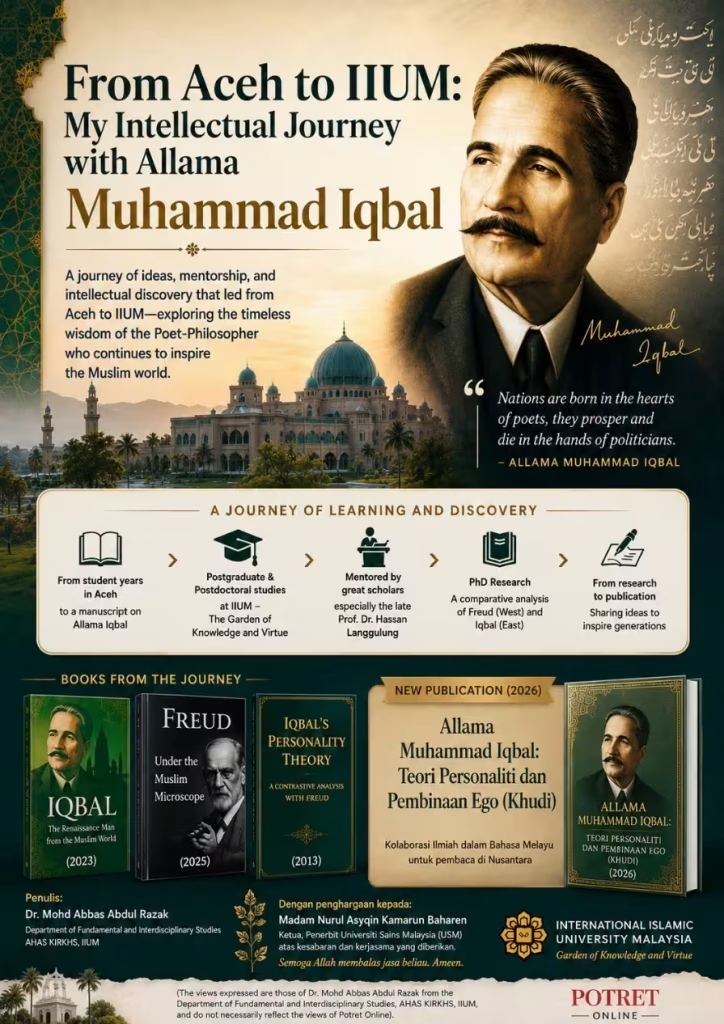
Later, in 2013, my dissertation was published in book form by Lambert Publishing House under the title ‘Iqbal’s Personality Theory: A Contrastive Analysis with Freud’. Since the book was rather bulky, comprising about 408 pages, I felt that it would be difficult for students to grasp all the ideas presented in it. This realization gave rise to a new idea.
I decided to divide the book into two separate volumes. One would focus exclusively on Iqbal, while the other would be devoted to Freud. Consequently, the section on Iqbal’s theory of personality was published as an eBook by the faculty to which I was attached. The book was titled ‘Iqbal: The Renaissance Man from the Muslim World (2023)’.
The second eBook, which focused on Freud’s theory of personality, was published in 2025 under a catchy title, ‘Freud Under the Muslim Microscope’. In the publication of both books, I invited co-authors to contribute their expertise and provide diverse perspectives on the subject matter. For the book on Iqbal, Dr. Salah Machouche served as my co-author, while Prof. Dr. Mumtaz Ali was the co-author of the book on Freud.
In my latest attempt to promote the philosophical ideas of Iqbal, the poet-philosopher who is the pride of the Muslim world, a book has been written in Malay for his admirers in the Nusantara region (Malay Archipelago). This book project is a collaborative research undertaken by my co-author, Assoc. Prof. Dr. Shaik Abdullah Hassan Mydin of USM (Universiti SainsMalaysia) and I, representing IIUM (International Islamic University Malaysia). As a man who normally writes in English, this book marks my first attempt in the Malay language. This book, which will be out for sale in the coming months, is titled ‘Allama Muhammad Iqbal: Teori Personaliti dan Pembinaan Ego (Khudi)’(2026).
This two-year project is a reworking of my undergraduate research on Iqbal. Originally written in Bahasa Indonesia, the adaptation into Bahasa Melayu and the addition of fresh and more interesting content on Iqbal were meticulously monitored by Madam Nurul Asyqin Kamarun Baharen, who heads PenerbitUniversiti Sains Malaysia (USM), the university’s publishing house.
As the authors of this new book on Iqbal, my co-author and I are truly grateful to Madam Nurul for her patience and cooperation right from the beginning until the successful completion of this book project. May Allah the Almighty reward her abundantly for her dedication and sincere assistance. Ameen.
(The views expressed are those of Dr. Mohd Abbas Abdul Razak from the Department of Fundamental and Interdisciplinary Studies, AHAS KIRKHS, IIUM, and do not necessarily reflect the views of Potret Online).