The Road to Iqbal: My Journey in Aceh

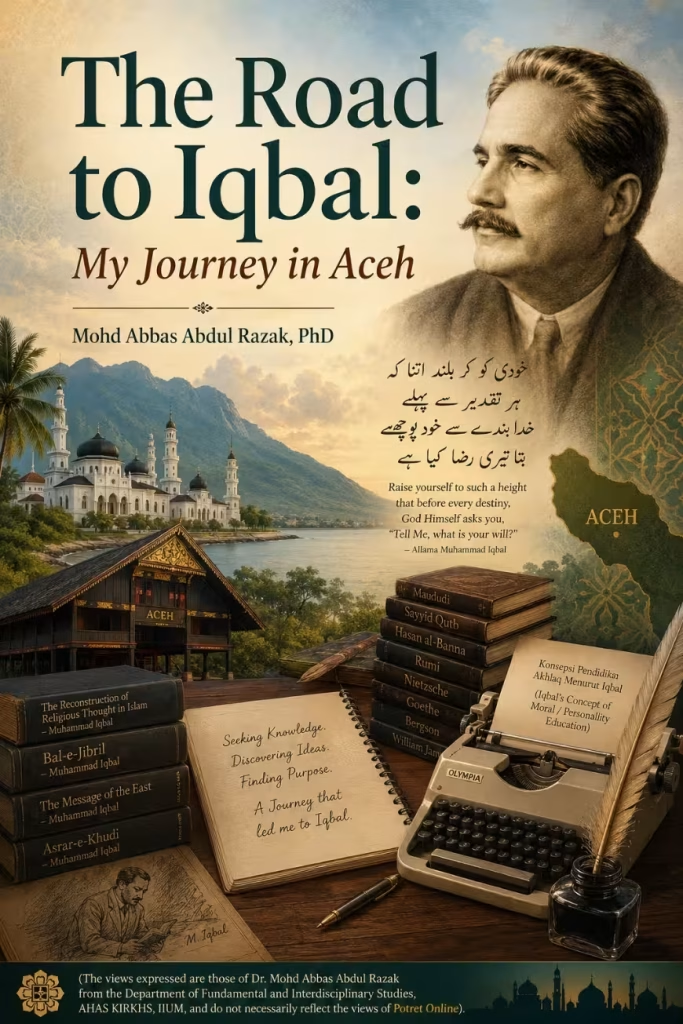

Mohd Abbas Abdul Razak, PhD
As a young high school graduate, I felt a strong inclination towards Islam, its worldview, practices, and philosophy of life. In the small town where I lived, the only places I could go to quench my thirst for Islamic knowledge and understanding were the local mosques, the public library, and second-hand bookshops.

Living at a time when the internet, social media, and other sophisticated means of communication were nonexistent in my life, reading was the best way to broaden one’s intellectual horizons. As a young man of that era, I immersed myself in books on religion and literature, as well as the monthly issues of National Geographic. They served as a lens through which I sought to understand the world around me.
At a time when I was enthusiastically devouring the ideas of Abul A‘la al-Maududi (1903–1979), Maryam Jameelah (1934–2012), Sayyid Qutb (1906–1966), Hasan al-Banna (1906–1949), and others, I was introduced to the ideas of Allama Muhammad Iqbal (1877–1938) through a lecture delivered by an Indian Muslim scholar from the Indian subcontinent.

The many verses of Iqbal’s poetry recited during that lecture fascinated me and stirred my interest in gaining a deeper understanding of his philosophical thought. My first attempt to understand Iqbal was through his magnum opus, The Reconstruction of Religious Thought in Islam.
At that tender age, and without any background in philosophy, I was disappointed in my efforts to acquaint myself with Iqbal’s ideas.

Yet that disappointment did not remain unanswered. God, the Creator of opportunities, opened a new window for me when I was given the chance to pursue my undergraduate studies in Aceh, Indonesia.
My journey to Aceh in the mid-1980s brought with it many pleasant surprises. Although Aceh was then one of Indonesia’s more laid-back provinces and lacked much of the infrastructure found elsewhere, it was home to many distinguished Muslim scholars, including Prof. Ali Hasjmy (1914–1998), Prof. K.H. Ibrahim Husein (1917–2001), Prof. Syafwan Idris (1946–2000), and countless others.
While attending lectures at IAIN-Ar-Raniry (now known as Universitas Islam Negeri Ar-Raniry), a reputed institution of higher learning, I once again developed a keen interest in understanding Iqbal. The campus library and the bookshops in the downtown area became valuable sources of information on his life and thought.
Although Islamic Studies was my area of specialization, I devoted a considerable portion of my semester breaks to reading Iqbal.
Reading about Iqbal’s profound love for the Prophet of Islam, his deep reverence for Maulana Jalal al-Din Rumi (1207–1273), and his appreciation of Western thinkers and philosophers such as Friedrich Nietzsche (1844–1900), Johann Wolfgang von Goethe (1749–1832), Henri Bergson (1859–1941), William James (1842–1910), as well as his own teachers and mentors, including Sir Thomas Walker Arnold (1864–1930), J. M. E. McTaggart (1866–1925), and Reynold Alleyne Nicholson (1868–1945), always fascinated me and inspired me to explore more deeply the development of Iqbal’s thought.
Since my undergraduate days, I have always been interested in reading about history, civilization, and the ideas of great scholars and thinkers, both from the East and the West. As a qualitative researcher by inclination, I enjoy exploring ideas and trying to understand the people behind them.
Towards the end of my studies at IAIN, one of the requirements for obtaining a degree was to conduct a research project and defend it before a viva voce examination committee. Only after the research had been accepted and approved would a student be awarded a degree.
At that stage of my life, I regarded thesis writing and the viva voce examination merely as requirements for graduation. It was only later, during my postgraduate studies at the Master’s, PhD, and postdoctoral levels, that I came to appreciate the real value of conducting research, writing a thesis, and defending one’s findings before a panel of examiners. Looking back, I now realize that these academic exercises played an important role in developing my ability to think critically, conduct research systematically, and communicate ideas with confidence.
While most of my friends were involved in quantitative research that dealt with statistical analysis, I took the bold decision to conduct a qualitative study on the ideas of Iqbal. The exact title of my study was Konsepsi Pendidikan Akhlaq Menurut Iqbal, which translates as Iqbal’s Concept of Moral Education.
It was only years later, during my postgraduate studies, that I realized the title did not fully reflect the ideas of Iqbal. Looking back, a more suitable translation of my Indonesian thesis would have been Iqbal’s Concept of Personality Education.
At this juncture of my article on Iqbal and Aceh, I am compelled to acknowledge the help and willingness of Drs. Ramly Maha and Drs. Umar Ali Aziz, who guided me in writing my thesis. In particular, Pak Ramly, who at the early stages of my proposal writing doubted my ability to understand Iqbal, gave me several books as reading assignments.
After a month, when I returned to his office, he conducted an oral test to assess whether I had understood Iqbal’s conceptual framework related to my topic. Thank God, my industrious reading and hard work enabled me to taste the fruit of my labour.
So pleased was he with my articulation of ideas and the outline of my study that he gave me the privilege of not reporting to him again until the full thesis was completed. Such a privilege was rarely granted in a campus with thousands of students.
Winning his confidence and approval placed a great responsibility on my shoulders. Since Pak Ramly was the Dean of the Faculty of Education, I vowed to myself that I would write a thesis of which he could be proud.
With a clear direction in mind and God on my side, I was able to complete the thesis within a relatively short period of time. When the completed manuscript was typed on an Olympia portable typewriter and submitted to him, he was very pleased and did not call for any major corrections.
The only suggestion he made was that I should add a sentence in the abstract indicating that, in a way, Iqbal had been influenced by the philosophical ideas of Friedrich Nietzsche (1844–1900) in developing his own concept of the human ego.
Although I had a slightly different interpretation of Iqbal’s admiration for Nietzsche, out of the respect I had for Pak Ramly, I agreed to include the sentence suggested by my principal supervisor.
(Kindly await my next posting on Iqbal the poet-philosopher.)
(The views expressed are those of Dr. Mohd Abbas Abdul Razak from the Department of Fundamental and Interdisciplinary Studies, AHAS KIRKHS, IIUM, and do not necessarily reflect the views of Potret Online).