Sebelum Filsafat and the Importance of Thinking

Written by Mohd Abbas Abdul Razak, PhD

Sebelum Filsafat is a brilliantly written philosophical work by Indonesian academic Dr. Fahruddin Faiz. Originally published in Indonesia in 2013 under the title Falsafah Terdahulu, it was later translated into Malay and released in 2024 by Cendekia & MJS Press. In the author’s home country, the book has gone through eight reprints—a testament to its popularity and the positive reception of both the work and its author. In all my philosophy classes, this book has consistently been recommended alongside other essential texts in English.
Dr. Fahruddin Faiz, is a scholar who hails from Mojokerto, East Java (Jawa Timur), Indonesia. He did his undergraduate in the Department of Aqidah and Philosophy at UIN Sunan Kalijaga Yogyakarta in 1998, his master’s degree in the Department of Religion and Philosophy at the same university in 2001, and his doctoral degree in the Department of Islamic Studies at UIN Sunan Kalijaga in 2014. Currently, he serves as a lecturer and vice dean at the Faculty of Ushuluddin and Islamic Thought at UIN Sunan Kalijaga Yogyakarta. In addition, he is actively involved as a writer and speaker in various religious and intellectual forums across Indonesia. Ever since 2013, Dr. Fahruddin has been conducting classes on philosophy at Masjid Jendral Sudirman, Yogyakarta.
Unlike most works on philosophy, the language used in this book is made accessible for undergraduate students and others with an interest in the subject. The author communicates his philosophical ideas in a more discursive style. The book contains less jargon than is typically found in works by other authors. This simplified approach makes the book more appealing, even to those who might not usually be interested in philosophy. To date, Dr. Fahruddin Faiz has authored more than fourteen books, primarily exploring themes of philosophy, spirituality, and everyday human life.
World Philosophy Day at IIUM

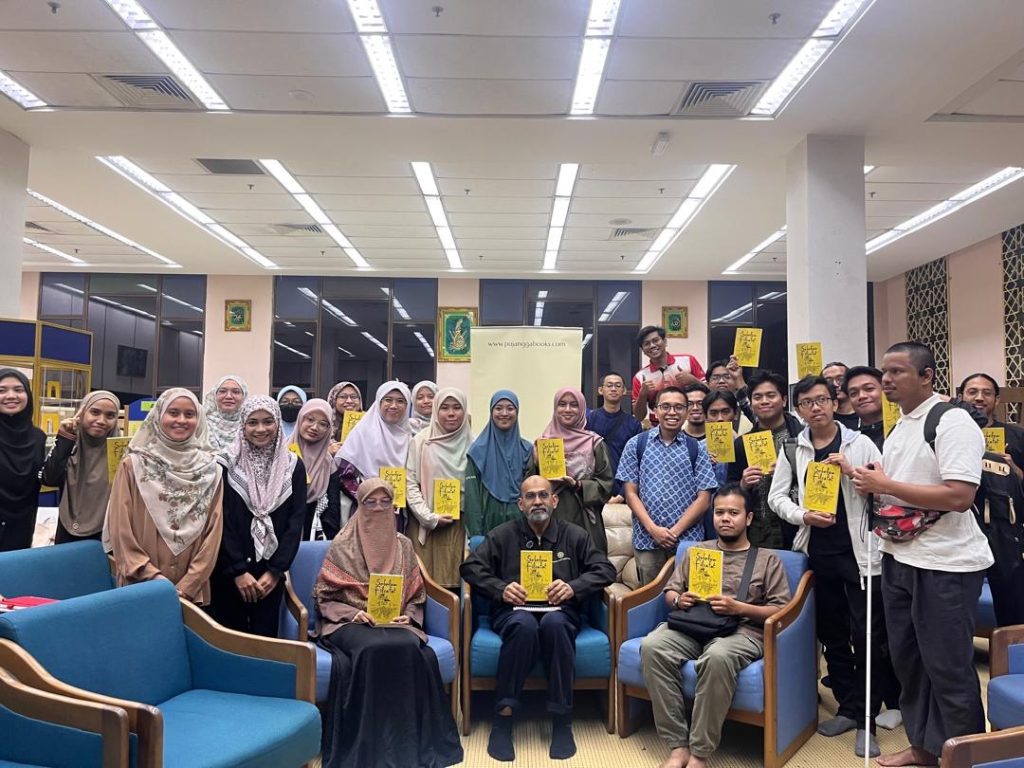
On 21st November 2024, my undergraduate students at the International Islamic University Malaysia organized, for the first time, a book review session in conjunction with World Philosophy Day. The book that I was assigned to review was none other than Sebelum Filsafat, a work on philosophy. For the session, the organizing committee had invited one of Malaysia’s young authors, Nik Nur Madihah, to join as the co-presenter. Both Madihah and I were asked to speak on the importance of doing philosophy in life (Peri Penting Falsafah Dalam Kehidupan). Alhamdulillah, the turnout that evening was encouraging. My good student, Tariq, who was very articulate during my philosophy class, was present as well. Realizing his presence that evening gave me an extra boost for my presentation.
Madihah, the author of books such as Noktah Terjahit(2024), Denai Cinta (2024), and Kemelut: KonflikPerasaan yang Sering Dilalui Pelajar (2025), delivered an excellent presentation. The presentations that evening worked their magic—many attendees ended up purchasing a copy of Sebelum Filsafat.
My First Encounter with Sebelum Filsafat
A fortnight before the book review event was held, students from the organizing committee came to my office to present me with the invitation letter and a copy of the book. The event was scheduled at a time when I was occupied with classes, student counselling, thesis evaluations, and meetings at various levels within the university. Upon receiving the book, I placed it among other academic titles in my office, where it remained until, just a few days before the review event at the M. Kamal Hassan Library of IIUM, I finally managed to steal some time to browse through it.
To be honest, reading and trying to understand the ideas presented in the book turned out to be far easier than I had expected. Many of the author’s ideas resonated with what I have long taught in my classes. A quick reading and some notetaking gave me a rough idea of how to present the review and handle the question-and-answer session.
Highlights from Sebelum Filsafat
Since philosophy in the Muslim world is often associated with certain polemics, the title of the book offers readers a sense of what one should understand about philosophy before taking a deeper plunge into it. In a way, the book helps to clear the mist that surrounds the subject. Simply put, it can be seen as a foundational work for engaging in philosophy. The author divides the book into fourteen chapters, with discussions centred on questions such as: What is philosophy? Why do we need to engage in it? How can philosophy lead us to wisdom? What is the state of mind of a philosopher? And what are the ten things philosophy demands of its students? — among other topics. As an academic who loves and teaches philosophy, the author believes that one can be a believer in God and, at the same time, can develop a philosophical mind. In addition, he believes one can be wiser by doing philosophy.
My Perception of Philosophy and Philosophers
Philosophy is a discipline that challenges us to think, not just in the ordinary sense, but deeply, critically, creatively, analytically, and contemplatively. Philosophers are often exceptional individuals, willing to venture down untrodden paths in their pursuit of truth and understanding. Many Western philosophers sought truth independently of religion, sacred texts, or prophetic teachings. In contrast, Muslim philosophers during the Islamic Golden Age (750–1258) often engaged with philosophical questions through the lens of religious tradition. Despite these differences, the primary tool of philosophy remains the same: the thinking mind.
Science explains how we came to exist on this planet and how to sustain life. However, it offers no answers to what happens to us when we leave this world. While science has advanced transportation, communication, healthcare, and many other aspects of modern life, it falls short in addressing the deeper question of life’s purpose.
In the realm of science, truth is determined through tangible data—what can be seen, touched, heard, or measured. According to a well-known scientific principle, if something cannot be measured, it is often considered not to exist. In essence, science connects the natural world to the human mind through empirical evidence.
In contrast, religion and philosophy delve into questions such as the purpose of human life, the relationship between humanity and the divine, how individuals relate to one another, the ideal relationship between humans and nature, the functioning of the body and soul, and the fate of the soul after death. They also explore concepts of good and evil, happiness, and the meaning of death. Unlike science, religion and philosophy speak not only to the mind, but also to the heart and soul.
Frequently Asked Questions
What opportunities can philosophy offer students, and where can it take them? As a discipline that challenges individuals to think critically, creatively, and beyond conventional boundaries, philosophy can prepare students to become exceptional leaders, politicians, debaters, writers, or members of think tanks.
Looking at the benefit of philosophy in producing good leaders, it reminds me of Plato (c. 428/427–348/347 BC), who used the term philosopher-king. To Plato, the ruler should be someone who possesses wisdom, is morally grounded, loves the truth, rules in a just manner, and is not someone who is obsessed with power or wealth.
In relation to what Plato said, I am also reminded of the life of Marcus Aurelius (121–180 AD), the wise Roman emperor and a Stoic philosopher who wrote Meditations. As a Muslim, I find myself agreeing with many of the beautiful ideas he expressed in his writings and quotes.
In the past, the Muslim world witnessed such exemplary leaders—like Prophet Muhammad (SAW) (570–632 AD), the four rightly guided caliphs: Abu Bakr (573–634 AD), Umar ibn al-Khattab (584–644 AD), Uthman ibn Affan (576–656 AD), and Ali ibn Abi Talib (600–661 AD), as well as Sayyidina Umar bin Abdul Aziz (682–720 AD), Salahuddin al-Ayyubi (1137–1193 AD), and Sultan Muhammad al-Fateh (1432–1481 AD).
At present, however, there are only a few leaders who are able to keep themselves close to what has been stated in the Holy Qur’an and Hadith.
My Last Word
I highly recommend students of the Malay Archipelago (Nusantara) to keep an open mind and read Sebelum Filsafat/Falsafah Terdahulu and other books on philosophy. In addition to reading the Qur’an and Hadith, they are encouraged to explore philosophical works, as these will broaden their horizons and deepen their thinking.
I know that thinking can be difficult and exhausting, but believe me—when you engage in it consistently, it will open new avenues for intellectual growth. With that growth, not only will you benefit, but so will those around you. So, keep on reading and thinking. May Allah guide and bless us all.
(The views expressed are those of Dr. Mohd Abbas Abdul Razak from the Department of Fundamental and Interdisciplinary Studies, AHAS KIRKHS, IIUM, and do not necessarily represent the views of Potret Online.)