The Rise of IIUM as a Leading Choice for Indonesian Students

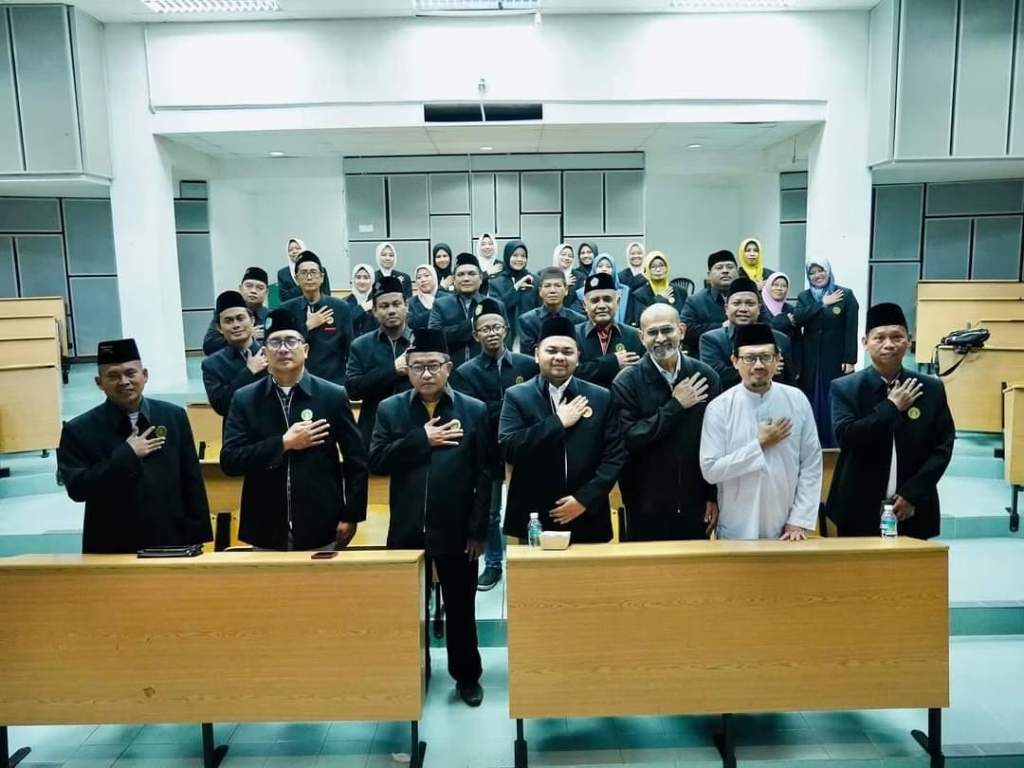
Written by: Mohd Abbas Abdul Razak and Muntaha Artalim Zaim
Introduction

Malaysia, Indonesia, and Brunei, as Muslim countries in the Southeast Asian region, have long enjoyed mutual understanding and strong relationships. Among the three, there are many similarities in terms of food, language, culture, Islamic denomination, ethics, and more. Being Muslim-majority countries, their non-Muslim minorities live in total peace and harmony. These nations are also well-respected among other members of ASEAN (Association of Southeast Asian Nations).
Although minor issues occasionally arise between Indonesia and Malaysia, particularly concerning domestic workers and foreign labour employed in Malaysia, such matters are typically resolved amicably, in the spirit of Islamic brotherhood and ASEAN cooperation. The way these issues are managed among Muslim countries in the Malay world can serve as a good example for Muslim nations in the Middle East.

For decades, Malaysia has been a popular destination for Indonesians seeking medical treatment and leisure. Cities such as Penang, Kuala Lumpur, and Melaka regularly attract Indonesian visitors for medical consultations and procedures. At the same time, Indonesian workers have played a crucial role in the development of key infrastructure in Malaysia, contributing to the construction of iconic landmarks in Kuala Lumpur and Putrajaya.
In return, Malaysian investors have made significant inroads into Indonesia’s palm oil sector, managing large-scale plantations that generate substantial employment opportunities for Indonesians. Meanwhile, Brunei, a wealthy Malay sultanate rich in oil resources, maintains considerable investments in both Indonesia and Malaysia.

After outlining the strong ties and ideal cooperation among these three Muslim-majority nations in the Malay Archipelago, this article will explore why the International Islamic University Malaysia (IIUM) has emerged as a preferred study destination for many aspiring Muslim scholars from Indonesia.
IIUM
The International Islamic University Malaysia was established on 23rd May 1983. It has earned a reputation as one of the best Islamic learning institutions in the Muslim world. Its student population hails from all continents, making it truly international. As an international university, it uses Arabic and English as its medium of instruction.
A salient feature of the university, being Islamic from its inception, is its philosophy of integration and Islamization of knowledge. Students at the university are exposed to the best ideas from both the Western and Muslim worlds. In addition to its diverse student population, one can witness the presence of some of the world’s finest minds on campus and in lecture halls, sharing their knowledge and wisdom.
Among its teaching staff, scholars of other faiths are also given opportunities to teach in the human sciences. IIUM’s mission, to produce students who are God-conscious and capable of becoming responsible leaders of the future, guiding the Ummah in their respective countries, makes it an appealing choice for both local and international students to pursue their studies.
IIUM’s approach to teaching is not solely theoretical, but also practical. In addition to classroom interaction, students are trained in crisis management, leadership skills, and public speaking. As an Islamic institution, IIUM requires all students, regardless of their faculty, to participate in spiritual enhancement programs. These programs help students understand that Islam is more than just a set of rituals; they are encouraged to view Islam as a comprehensive way of life, fostering a deeper and broader perspective of their faith.
Islamic Learning Institutions in Indonesia
Indonesia today is a more progressive nation compared to what it was in the bygone years. Compared to a few decades ago, both Indonesia and its people have become more developed. In addition to advancements in infrastructure, people are now more aware of global events and developments. On the positive side, the advent of computers, the Internet, and social media has empowered the masses, especially the student population, with greater access to knowledge and improved language skills.p

(Undergraduate Students from Universitas Negeri Padang, Indonesia, Visiting IIUM)
As a result of these recent developments, students are more ambitious and eager to learn, contributing in various positive ways toward national development. At present, Indonesian scholars and students can stand tall alongside their counterparts from around the world.
We are proud to note that, along with the progress in mainstream education, Islamic traditional schools and colleges have also developed tremendously. In these institutions, students excel not only in Arabic but also in English. Furthermore, they are proficient in technology-mediated learning. Credit must be given to the teachers, who have successfully adapted to new methods of teaching and conducting research.
At the tertiary level, Indonesian academics are publishing research papers at the international level. Their proficiency in English has enabled them to be on par with their peers in the region and around the world. Their dedication and competitiveness as scholars have contributed to a significant increase in the number of journal publications originating from Indonesia.
IIUM Attracts Academics and Students from Indonesia
In recent times, we have observed an increase in the number of academics and students from Indonesia visiting IIUM. During casual conversations with these visitors, we discovered that many are drawn to IIUM for its Islamic approach to education and learning. Some are attracted by its strong reputation in the Muslim world. A few also believe that pursuing education at IIUM enhances their knowledge and skills, particularly in disseminating knowledge in both English and Arabic.
(Students from Al Mashduqi Islamic School Garut, West Java,Indonesia.)
Many Indonesian students who visit IIUM from high schools are seeking a reputable university to pursue their tertiary education. In addition to this group, there are also students currently pursuing their undergraduate studies in Indonesia who are looking for a suitable university to continue with their postgraduate studies in Malaysia.
Moreover, many IIUM graduates have proven their credibility as respected Muslim scholars in Indonesia. In discussions with IIUM officials, we also learned that several graduates in Islamic Banking and Finance now hold strategic positions in Indonesia’s banking sector. Perhaps the icing on the cake is the inspiring story of an Indonesian student who was appointed as a teaching staff member at IIUM, and after several years, returned to Indonesia and is now serving as the rector of an Islamic university.
Compared to Indonesian students who visit IIUM, academics have their own distinct reasons. Many of these educators are interested in learning the methods employed at IIUM for disseminating knowledge and Islamic values to its student population. At the institutional level, numerous university officials from Indonesia visit IIUM to sign memoranda of understanding (MoU) and to establish collaborations in research.
With recent advancements in technology, particularly the use of Zoom and other online platforms, IIUM and its Indonesian counterparts now conduct virtual conferences that require minimal budgets. These conferences provide valuable opportunities for academics from both Muslim countries to exchange research findings that can benefit both Indonesia and Malaysia. At times, such events also include participation from Brunei and other Muslim countries around the world.
Why IIUM?
The International Islamic University Malaysia has become the university of choice for many Indonesian students for several reasons. First and foremost, studying at IIUM is significantly more affordable compared to studying in the United States or other European countries. Additionally, IIUM is home to many distinguished academics from Europe, the Arab world, the Indian Subcontinent, the Malay world, and other parts of the globe.
Some Indonesians also believe that, given the current global instability, studying in the Middle East may not be the best option. For most Indonesians, it is an undeniable fact that studying in Malaysia poses fewer challenges, as they find it easy to adapt to the climate, food, culture, language, and religious practices.
What Indonesia and Malaysia Can Do
In light of the growing interest among young Indonesians who are eager to pursue their undergraduate and postgraduate studies at IIUM, both the Indonesian and Malaysian governments should take proactive measures to expedite the issuance of passports and visas for these students. Enhanced understanding and cooperation between the two governments can significantly boost student enrollment at IIUM. In addition to supporting Indonesian students seeking education in Malaysia, Indonesia should also extend similar support to Malaysian students who wish to experience student life in Indonesia.
Concluding Remarks
As we witness war, racism, and religious prejudice occurring in many parts of the world, we place our hope in countries like Indonesia, Malaysia, and Brunei, nations that have long enjoyed mutual understanding and are known for their commitment to peace. It is vital that they continue to stand together in the spirit of Islam and the shared heritage of the Malay world. In addition to trade and other forms of cooperation, these countries have the potential to produce future Muslim leaders through collaboration in the field of education. To foster deeper understanding among the three nations, a student exchange program is greatly needed. We sincerely hope that strong unity among Muslim countries in the Malay world can shine as an example for the rest of the Muslim world.
(The views expressed are those of Dr. Mohd Abbas Abdul Razak, Department of Fundamental and Interdisciplinary Studies & Dr. Muntaha Artalim Zaim from the Department of Fiqh and Usul Fiqh, AHAS KIRKHS, IIUM, and do not necessarily reflect the views of Potret Online.)