


By Dr. Al Chaidar Abdurrahman Puteh, M.Si
Dosen Antropologi, Universitas Malikussaleh, Lhokseumawe, Aceh
In the heart of Salem, Massachusetts, a centuries-old emblem has become the center of a heated debate. The Salem City Seal, designed in 1839 by George Peabody, depicts a Sumatran merchant—believed by many historians to be an Acehnese nobleman named Po Adam—standing beneath palm trees with a ship in the background. Dressed in traditional gombrong attire and holding a parasol, the figure symbolizes Salem’s pivotal role in the pepper trade with Sumatra during the late 18th and early 19th centuries.
Yet in 2025, the seal faces calls for removal. Some residents argue that the image is racially insensitive, with claims that it caricatures Southeast Asians or is offensive to Chinese communities. The controversy has prompted the formation of a City Seal Task Force, charged with reviewing the seal’s historical context and recommending whether it should be changed.
The controversy surrounding Salem’s City Seal, which actually depicts an Acehnese merchant from Sumatra and not a stereotyped image of a Chinese figure, reveals a disconnect between historical understanding and contemporary activism.
What’s remarkable is that the seal commemorates Salem’s maritime legacy in the pepper trade, a partnership with Southeast Asian communities—specifically Aceh—that elevated Salem to global prominence in the early 19th century. Far from being exploitative, it honors a transoceanic relationship based on trade, diplomacy, and cultural exchange.
Some critics may view the image through a framework of colonialism or orientalism, but historical accounts—including those cited by Professor Michael Feener—emphasize that it reflects a nuanced and respectful encounter. The figure is dressed in traditional gombrong attire, standing dignified with a parasol, and framed by a ship that symbolizes mutual trade routes, not domination. It’s a symbol of courage and exploration, not caricature.
So yes, the movement to erase such imagery, while rooted in good intentions, can inadvertently overwrite valuable narratives that deserve deeper appreciation—not censorship. If the seal changes, what’s lost isn’t just an image, but a story of global connectivity and respect between peoples.
A Seal Rooted in Global Trade
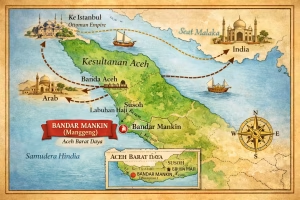
The seal’s origins trace back to Salem’s golden age of maritime commerce. In 1797, Captain Jonathan Carnes returned from Sumatra aboard the Rajah, carrying a cargo of wild pepper valued at over $125,000—equivalent to $1.5 million today. This voyage marked the beginning of Salem’s dominance in the pepper trade, with over 179 American ships visiting Aceh between 1654 and 1846.
Rather than depicting Salem itself, Peabody chose to honor the city’s international legacy by illustrating a Sumatran merchant. The Latin motto beneath the seal, Divitis Indiae usque sinum (“To the farthest port of the rich east”), reinforces this global vision.
Critics of the seal argue that the depiction is outdated and racially reductive. Some claim it perpetuates colonial imagery or misrepresents Asian identities. However, historians and cultural scholars—including Professor Michael Feener—have pushed back, noting that the figure is not Chinese but Acehnese, and that the seal honors a historical partnership rather than exploits it.
Feener draws parallels to past protests, such as those opposing the U.S. Congress’s decision to send the USS Potomac to bombard Kuala Batee in 1832—a response to a piracy incident that disrupted Salem’s pepper trade. He suggests that the current debate echoes earlier tensions between historical memory and political action.
Scholars Defend the Salem City Seal: Preserving History Amid Misunderstandings
As calls to remove the Salem City Seal intensify, three leading experts—Professor Michael Feener, Dr. Reza Idria, and Prof. Cut Dewi—have stepped forward to clarify the seal’s origin and symbolism. Contrary to recent claims that the seal depicts a stereotyped Chinese figure, the scholars confirm the man shown in the seal is an Acehnese noble, representing a respectful portrayal of Salem’s diplomatic and trade relationship with Sumatra in the early 19th century.
Professor Michael Feener
A distinguished historian of Islamic and Southeast Asian history, Feener emphasizes that the seal honors Po Adam, a well-known Acehnese merchant. He notes that the seal commemorates the pepper trade—a transformative moment when Salem’s ships navigated across the globe to build peaceful and prosperous relationships in Asia. To label the seal racist is, in his view, a misreading of its intent and historical context. He draws comparisons to the protests that occurred when Congress sent the USS Potomac to Kuala Batee in the 1830s—tensions then, like now, often ignored the deeper historical relationships at play.



Dr. Reza Idria
An anthropologist and Acehnese scholar who completed his doctorate at Harvard, Dr. Idria defends the seal as a symbol of transcontinental partnership. He argues that reducing the seal to racial caricature erases the rich history between Salem and Aceh. “The figure on the seal is not a cartoon,” he has said in academic circles. “It’s a tribute to a real, diplomatic relationship between a Western town and an Eastern sultanate—rare and honorable in its time.” He urges not only cultural sensitivity but historical accuracy, suggesting that Indonesia should engage through cultural diplomacy to preserve the truth behind the symbol.
Professor Cut Dewi
A leading figure in cultural preservation and architecture, Prof. Dewi offers insight into the aesthetics and iconography of the seal. She insists the portrayal is rooted in respect and shared legacy, not in distortion. “Erasing the seal,” she warns, “risks erasing collective memory.” She advocates for contextual education around the seal so that future generations understand its global significance and the historical integrity it carries.
Together, these scholars champion a more thoughtful approach—one that recognizes the Salem City Seal not as a relic of prejudice, but as a symbol of cross-cultural respect and maritime achievement. They remind us that true equity includes honoring histories of collaboration, not just confronting wrongs.

Voices from the Community
In a public statement, Salem resident Tim Doggett defended the seal’s legacy:
“To change our present seal is to erase our history, and our place in the world, as if it never existed.”
Doggett emphasized that the seal commemorates a world-changing accomplishment—the opening of Pacific Asian trade routes—and that it reflects Salem’s unique identity, not a fleeting political trend.
Others have proposed alternative symbols, such as honoring local inventors like Timothy Dixon or Alexander Graham Bell. But supporters of the current seal argue that its global narrative sets Salem apart and deserves preservation.

The City Seal Task Force will continue its deliberations through 2026, hosting public forums and consulting historians, artists, and community members. As Salem approaches its 400th anniversary, the debate over its seal invites broader questions: How should a city honor its past? Can historical symbols coexist with modern values? Whatever the outcome, the conversation itself reflects a community grappling with its identity—rooted in history, yet responsive to change.[]
🔥 5 Artikel Terbanyak Dibaca Minggu Ini




Discussion about this post